
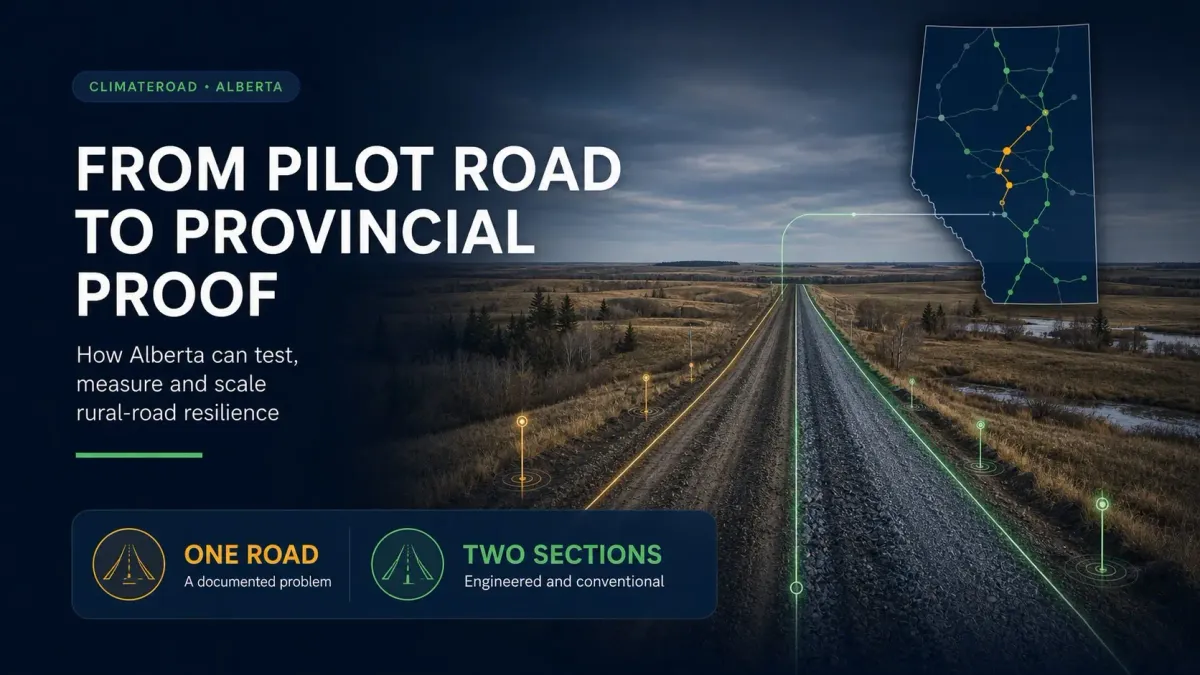
From Pilot Road to Provincial Proof
How Alberta can test, measure and scale rural-road resilience
Alberta does not need to decide whether one technology belongs across its rural-road network. It needs to decide whether a different road system can produce a better result on the right road, under controlled local conditions.
That is a much smaller and more useful question.
The first two articles in this series examined the scale of Alberta's rural-road challenge and the interaction among heavy loading, moisture, spring breakup and aggregate loss. The final step is proof: a demonstration that gives engineers, public works teams, finance leaders and councils evidence they can use together.
A demonstration is a decision instrument
A credible demonstration is not a showcase kilometre. It is a structured comparison designed to answer a procurement and asset-management question.
The question should be defined before construction begins: can an engineered intervention deliver the same or better service while reducing the maintenance resources consumed by a conventional road section with comparable conditions?
That framing protects both the road authority and the supplier. It prevents a positive-looking surface from being mistaken for a complete result, and it prevents one difficult season from being interpreted without a valid comparison. Most importantly, it turns the project into evidence that can support a future decision.
Start with the right road, not the easiest road
The strongest candidate is not necessarily the road most likely to make a treatment look good. It is a road where recurring maintenance is already signalling a defined problem and where changing that pattern would matter.
A candidate segment should combine several characteristics:
A documented history of grading, regravelling, rutting, soft spots, restrictions or emergency work
Meaningful agricultural, industrial, community or emergency-access importance
Traffic and axle loading that can be measured over the relevant operating season
A failure mechanism that can be investigated through drainage, aggregate and geotechnical assessment
A nearby conventional section with sufficiently similar conditions for comparison
A road authority willing to record work, costs and service outcomes consistently
A low-risk road with little maintenance history may be simple to treat, but it will reveal little about the economic case. A representative problem road creates a more valuable test because success can be measured against a burden that already exists.
One road, two sections, one evidence standard
The demonstration should pair an engineered section with a conventional control. Both sections should be as similar as practical in traffic, axle loading, geometry, aggregate, soil, drainage and exposure to weather.
The control matters because rural roads change for many reasons. Rainfall, frost depth, haul timing, grading decisions and drainage work can all influence performance. Without a conventional comparison exposed to the same season, it is difficult to know whether an observed improvement came from the intervention or from normal variation.
The purpose is not to create laboratory perfection. No two road sections will be identical. The purpose is to document the important differences, apply the same monitoring schedule and make the comparison transparent enough that municipal engineers and finance teams can judge it.
Build the baseline before building the road
A demonstration cannot prove maintenance avoided unless the current maintenance demand is known. The baseline should therefore be assembled before treatment selection and, where practical, observed through a representative operating period.
The baseline should record:
Surface condition, rut depth, crossfall, ride quality and wet-weather passability
Traffic volume, heavy-vehicle percentage, axle profile and seasonal haul timing
Aggregate depth, gradation and moisture susceptibility
Subgrade strength, drainage condition, culvert function and known water pathways
Grading frequency, grader hours, gravel quantities and delivered aggregate cost
Emergency repairs, road bans, service restrictions and closures
Labour, equipment, fuel and contractor costs by road segment
The service consequence of disruption, including detours and economic dependence
A municipality does not need to begin with a large construction commitment. A practical first step is to identify one or more roads that consume more gravel, grading time or emergency attention than expected and determine whether they are suitable for a controlled demonstration.
Diagnose first, select the intervention second
Climateroad's role begins with the road system, not a predetermined treatment.
The objective is to organize evidence on condition, traffic, climate, geotechnical factors, maintenance and consequences into a practical investment priority. That means identifying where conventional maintenance remains appropriate, where drainage or structural redesign is required and where an engineered intervention should be tested against a conventional control.
Depending on the diagnosed failure mechanism, a project may involve drainage correction, reshaping, weak-section repair, aggregate optimization, structural stabilization, surface protection or a combination of measures. Polyroads technologies may be considered where they fit the engineering need. They should not be applied simply because they are available.
For Alberta, the evidence standard must remain local. International experience may justify investigation, but it cannot demonstrate performance through Alberta's spring breakup, freeze-thaw cycles, soils, traffic profiles or municipal operating practices. That proof belongs in the Alberta demonstration.
Measure what the road authority can use
Laboratory results and structural indicators are important, but the eventual decision is operational and financial. The demonstration must show whether the road delivers an acceptable service level with a different demand on municipal resources.
Useful measures fall into four groups:
Engineering performance: strength, rutting, deformation, moisture response and surface condition
Service performance: passability, ride quality, restrictions, closures and recovery after severe weather
Maintenance demand: grading passes, grader hours, gravel replacement, dust control and emergency work
Economic performance: cost per kilometre per year, aggregate and haul cost avoided, payback and lifecycle value
The most persuasive result is not a percentage in isolation. It is a transparent comparison of dollars per kilometre per year, supported by the work records and service outcomes behind it.
Define the commercial threshold in advance
A pilot can perform better without performing well enough to justify broader use. Success must therefore have an economic threshold as well as an engineering threshold.
Before implementation, the participants should agree on the minimum result that would warrant the next decision. That may include a required reduction in grading or aggregate consumption, an acceptable service level through spring breakup, a maximum payback period or a lifecycle-cost advantage over conventional maintenance.
The threshold should be calculated from the municipality's actual costs, not a generic Alberta average. Gravel source, haul distance, equipment rates, labour practices, traffic and existing maintenance frequency can change the economics substantially from one county to another.
This discipline keeps modelled scenarios in their proper role. They can help design the pilot and test sensitivities, but they remain hypotheses until Alberta field data replace the assumptions.
From cost reduction to a capacity multiplier
For a municipality with a large network, the most valuable outcome may not be a smaller road budget. It may be the ability to maintain more serviceable kilometres with the same budget.
If an engineered section requires less recurring grading, gravel and emergency work, crews and funding can be redirected to roads that are currently receiving less attention than they need. The intervention then becomes a capacity multiplier rather than a stand-alone cost-saving measure.
That proposition is measurable. A road authority can track the number of serviceable road-kilometres maintained to a defined condition standard for every $1 million of annual operating and maintenance spending. If that figure improves without reducing service, the network has gained productive capacity.
This metric also connects the demonstration to the challenge identified by the Rural Municipalities of Alberta. Where the network's needs exceed available resources, the strategic objective is not merely to spend less on one road. It is to change how much reliable infrastructure the existing budget can support.
A practical path from pilot to scale
Scaling should occur in stages, with each stage answering a different question:
Screen: identify high-maintenance roads with a documented problem and meaningful consequence.
Diagnose: confirm the failure mechanism and determine whether an engineered treatment is appropriate.
Compare: construct matched engineered and conventional sections with a common baseline.
Monitor: record engineering, service, maintenance and cost outcomes through the conditions that matter.
Decide: compare the measured result with the pre-agreed performance and commercial thresholds.
Transfer: apply the finding only to roads with sufficiently comparable conditions, then continue monitoring.
A successful pilot does not prove that every Alberta road should receive the same treatment. It establishes an evidence envelope: the traffic, soils, moisture, drainage and maintenance conditions under which the result can reasonably inform another project.
Frequently asked questions
How large should the first Alberta demonstration be?
It should be large enough to include representative engineered and conventional sections, but small enough to monitor carefully. The appropriate length depends on road variability, drainage, traffic and the treatment being evaluated.
Why not begin with a province-wide procurement?
Performance and economics are site-specific. A controlled local comparison limits risk and provides the evidence needed to determine where wider application may be justified.
Does Climateroad replace the municipality's engineer or public works team?
No. A credible project is developed with the road authority and its engineering, operations and procurement requirements. Climateroad helps organize the diagnosis, intervention and evidence framework.
What would count as a successful result?
Success should combine engineering performance, acceptable service, reduced maintenance demand and lifecycle value. The specific thresholds must be agreed before the demonstration begins.
What happens after a successful pilot?
The result should first be applied to roads with comparable conditions. Additional operating environments may require further demonstrations before the evidence can support broader adoption.
The invitation to Alberta road authorities
The opportunity is not to select a product first. It is to identify a road where recurring maintenance is already signalling a deeper problem and determine whether a controlled comparison can produce a better lifecycle outcome.
Municipalities, counties, road authorities and industry partners can begin with one practical question: which road is consuming more gravel, grading time or emergency attention than it should?
Climateroad can help assess whether that segment presents a credible demonstration case, define what must be measured and build a path from local evidence to an informed infrastructure decision.
Sources
Rural Municipalities of Alberta, Transportation and Municipal Infrastructure position statement
Rural Municipalities of Alberta, Rural Municipal Infrastructure Deficit Project
Government of Alberta, Strategic Transportation Infrastructure Program
Government of Alberta, Resource Road Program
Government of Alberta, Equivalent Single Axle Loadings for pavement design
Government of Alberta, Road restrictions and bans
Alberta Transportation, Pavement Design Manual
Editorial note
This article proposes a demonstration and measurement framework. It does not claim a predetermined Climateroad or Polyroads performance result. Maintenance reductions, payback and lifecycle value must be established from site-specific Alberta data and a controlled comparison. International experience may support further investigation but is not presented as proof of performance under Alberta conditions.
