
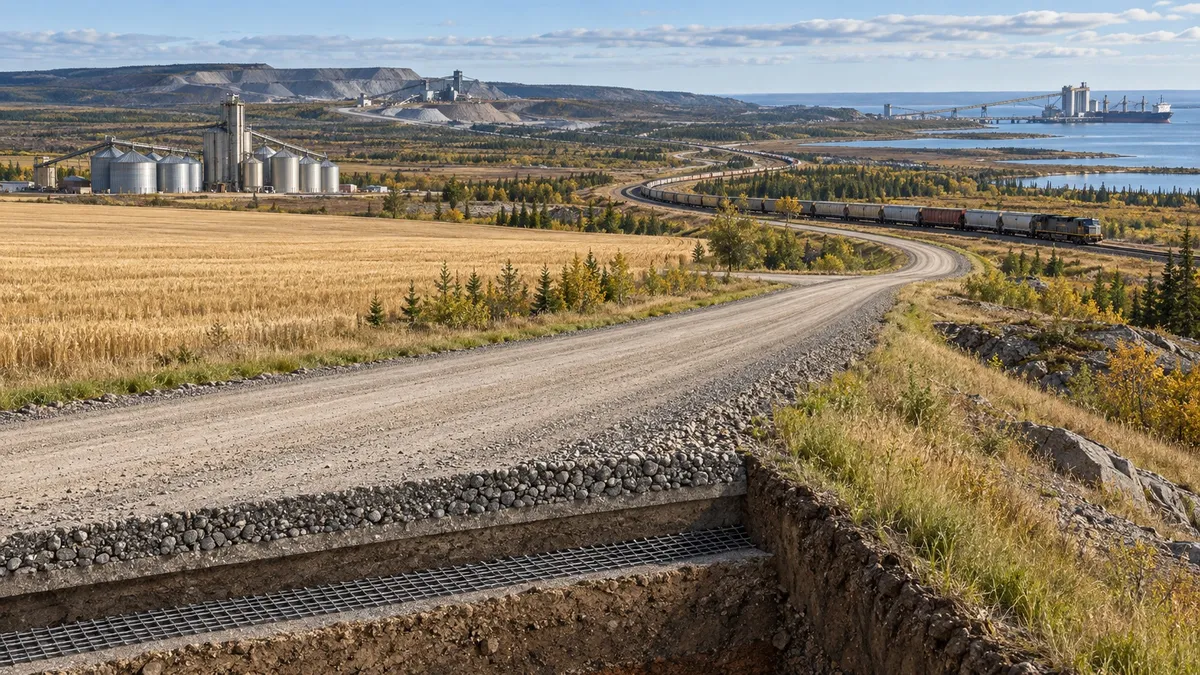
Manitoba's First Mile Is Export Infrastructure
Manitoba's export economy does not begin at a rail terminal or a port. It begins on the local road that carries seed and fertilizer in, moves crops and livestock out and connects rural production to the larger transportation system.
That first mile is often a gravel road maintained by a rural municipality. It may look local on a map but its economic role is provincial and increasingly international.
In 2025 Manitoba exported $9.04 billion in agri-food products, representing 45.9 per cent of the province's international exports. The province is also investing in the Port of Churchill and Hudson Bay Railway to expand trade opportunities for agriculture, mining, fertilizer and northern resupply. Each strategy depends on reliable access well before a shipment reaches rail or tidewater.
The export corridor begins before the highway
A corridor is only as reliable as the least dependable link within it. Grain elevators, processing plants, mines, rail lines and ports cannot create their full value if the road connecting production to those assets becomes unreliable during spring breakup, heavy rainfall or periods of concentrated truck movement.
This is why rural roads should be understood as first-mile export infrastructure. They are not separate from Manitoba's trade strategy. They are the entry point into it.
When a local road performs well, trucks move on schedule, agricultural inputs arrive when needed and communities retain reliable access to services and markets. When it fails, the effects move through the wider system as delays, detours, higher vehicle costs, disrupted production and emergency municipal spending.
The benefits travel farther than the bill
The economic benefits supported by rural roads flow across Manitoba and beyond. Export revenue, employment, processing activity and tax receipts reach provincial and national accounts. The incremental wear created by heavier and more frequent commodity traffic often lands first on the rural municipality responsible for the road.
That creates a structural mismatch between who benefits and who pays. A municipality may be maintaining a local asset that supports a much larger economic system while drawing from a comparatively narrow tax base.
The policy question is therefore larger than whether a municipality can grade a road often enough. It is whether the province's infrastructure and funding model recognizes the productive value carried by that road.
Municipal budgets reveal the pressure
The RM of Stanley's 2025 financial plan provides a useful public example. Transportation services represented roughly 37 per cent of total municipal expenditure. Gravel-road maintenance alone accounted for about 11 per cent before separately budgeted wages, fuel, equipment repairs, drainage work and culvert costs were considered.
Other Manitoba municipalities face their own versions of the same equation: extensive road networks, small populations, variable soils and drainage conditions and limited capacity to absorb an unexpected season of damage.
In 2022 the Manitoba government announced an additional $15 million for municipal road repairs following severe weather and flooding. Emergency funding may restore access but it also signals how quickly weather can convert road vulnerability into unplanned public cost.
Growth can intensify the first-mile problem
Economic growth is welcome but it adds physical demand. More agricultural production and resource development mean more truck movements, greater axle loading and more concentrated use during the same seasonal windows in which road strength may already be reduced.
Manitoba has already invested in heavy-weight commerce routes where road capacity constrains economic activity. That is an important recognition: infrastructure cannot support growth indefinitely if its design remains tied to an earlier traffic environment.
The challenge is not to choose between economic growth and road protection. It is to align road performance with the economy the province is building.
A better measure of infrastructure value
Traditional road decisions often focus on the initial project cost or the annual maintenance line. Those numbers matter but they do not capture the full service the asset provides.
A stronger measure is productive road capacity: the number of reliable and serviceable road-kilometres supported by each infrastructure dollar while carrying the traffic the economy requires.
This shifts the conversation from the price of gravel to the value of dependable access. It also creates a common language for municipalities, the province and the industries whose freight depends on the route.
From a maintenance asset to an economic platform
Manitoba's first-mile roads connect production, communities and public services to the wider economy. Treating them as productive infrastructure does not remove the need for responsible maintenance. It changes the objective.
The goal becomes preserving reliable access, extending asset life and increasing the amount of economic service the network can provide within a constrained public budget.
The next article examines why recurring grading and gravel replacement can struggle to achieve that goal when the underlying road structure is losing capacity.
Frequently asked questions
What is first-mile infrastructure?
It is the local infrastructure that connects production and communities to the larger transportation network. In rural Manitoba it often includes gravel roads linking farms, resource activity and communities to highways, rail and export gateways.
Why are rural roads part of Manitoba's export strategy?
Agricultural and resource products must travel from their point of origin to processing, rail or port facilities. An unreliable local road can interrupt the entire movement even when the larger corridor is operating well.
Why is the municipal funding model under pressure?
Municipalities may carry the direct maintenance cost while the economic benefits supported by the road extend across provincial and national economies. Long networks and limited local tax bases can make this imbalance difficult to absorb.
Does this mean every gravel road should be upgraded?
No. Investment should begin with roads that combine documented performance problems, meaningful economic or community consequences and conditions suited to an engineered intervention.
What should road authorities measure?
Useful measures include service reliability, traffic and axle loading, grading frequency, aggregate replacement, emergency repairs, lifecycle cost and the number of serviceable kilometres supported by the available budget.
