
Planning Climate-Resilient Road Infrastructure in Nova Scotia
Built Before the Next Storm
Turning climate exposure into stronger road, bridge and community investment decisions
Nova Scotia's recent experience with extreme weather reveals a difficult fiscal reality: climate disasters do not simply damage infrastructure. They consume the money, staff capacity and political attention needed to improve it.
Hurricane Fiona, the 2023 wildfires and the July 2023 floods occurred within a remarkably short period. Each affected different communities and infrastructure systems, but together they exposed the same underlying vulnerability. A small, geographically dispersed province must protect thousands of kilometres of coastline, roads, bridges, drainage systems, utilities and community connections with limited financial capacity and limited redundancy.
The question is no longer whether Nova Scotia will experience another damaging event. It is whether the province can identify its most consequential vulnerabilities and invest before the next event turns them into emergencies.
When disaster recovery competes with planned investment
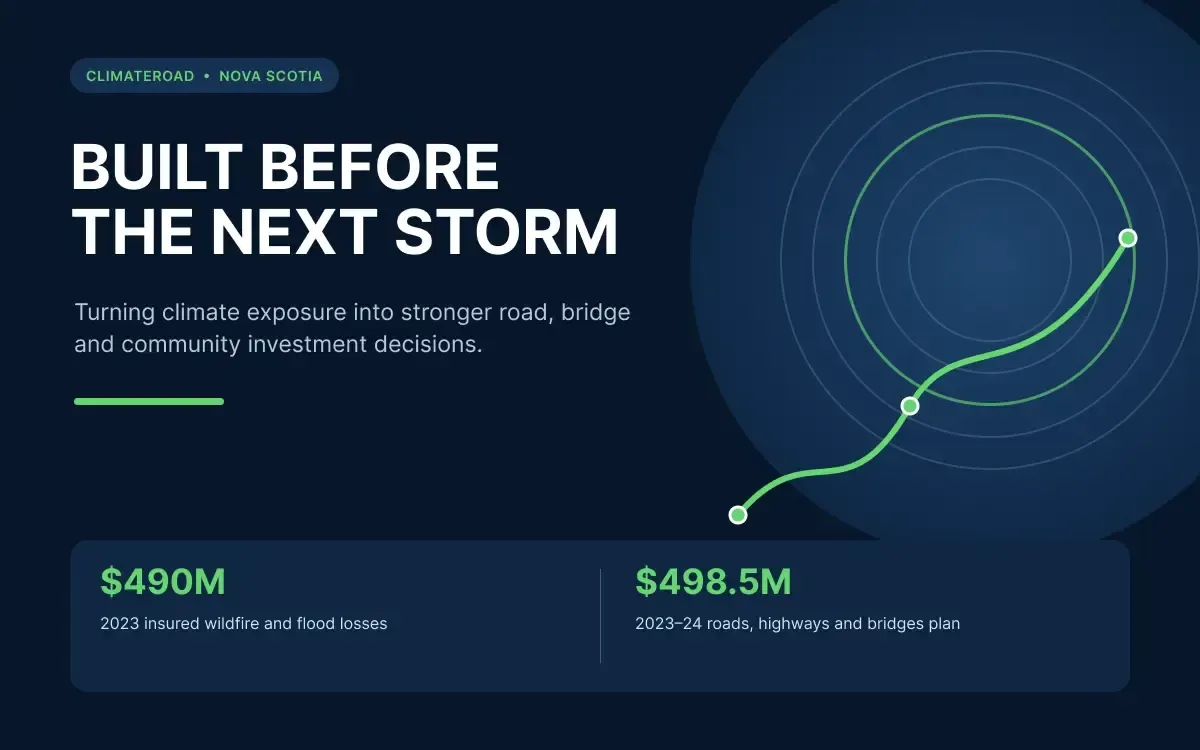
The scale of recent losses is striking. In 2023, Nova Scotia's wildfires and floods produced approximately $490 million in insured losses. This number does not capture the full cost of damaged roads, bridges, drainage systems, public facilities, uninsured properties or interrupted economic activity.
For comparison, Nova Scotia's 2023-24 allocation for roads, highways and bridges was $498.5 million.
The two figures are not directly interchangeable. Insured losses are not paid from the provincial transportation capital plan. The comparison nevertheless shows the scale of the challenge: a few weeks of extreme weather can produce losses comparable to an entire year of planned provincial investment in roads, highways and bridges.
The July 2023 floods provide a vivid example. Some areas received as much as 250 millimetres of rain over a very short period. Roads became rivers, communities were isolated and four people lost their lives. At least seven bridges required replacement or reconstruction, while another 19 needed repairs.
Hurricane Fiona had already demonstrated how quickly failures can cascade. Approximately 415,000 Nova Scotia Power customers experienced outages, while transportation, telecommunications and emergency-response systems were placed under simultaneous pressure.
These events were not only disasters. They were infrastructure stress tests.
Infrastructure designed for yesterday's climate
Much of Nova Scotia's infrastructure was designed using historical assumptions about rainfall, storm intensity, coastal conditions and wildfire risk. Those assumptions are becoming less reliable.
A culvert that was adequate for past rainfall patterns may now contribute to a road washout. A bridge that provides the only practical route into a community becomes a regional vulnerability. An overwhelmed stormwater system can damage homes, interrupt businesses and create public-health risks.
In a larger jurisdiction, network redundancy can help absorb individual failures. Nova Scotia often has fewer alternatives. Its population is distributed across numerous rural and coastal communities, increasing the per-person cost of maintaining infrastructure and making individual assets disproportionately important.
A lower-volume rural road can therefore be more critical than its traffic count suggests. If it provides the only dependable route to emergency care, a port, a major employer or an entire community, its loss has consequences far beyond the road itself.
The fiscal cycle of repeated repair
Extreme weather damages roads, bridges, culverts and public systems.
Emergency response and reconstruction consume available funding and staff capacity.
Planned maintenance and modernization are delayed.
Remaining infrastructure becomes more vulnerable to the next event.
Future recovery becomes more expensive and more disruptive.
Maintenance will always be necessary. The concern arises when the same location requires repeated intervention and each repair is treated as an isolated event. Recurring washouts, drainage failures, shoulder deterioration or seasonal access problems may indicate that the existing design or maintenance approach no longer matches the conditions affecting the asset.
A recurring repair is not merely a cost. It is information about how the infrastructure is performing.
Over time, reactive rebuilding can force governments to spend more restoring yesterday's systems while leaving less room to build the systems needed for tomorrow.
Moving from recovery to foresight
More infrastructure funding will be necessary, but funding alone cannot resolve the problem. No government can strengthen every road, bridge, culvert and public asset at once. The essential task is prioritization.
Decision-makers need to understand which assets face the greatest hazards, which failures would have the largest consequences, and where an investment today can prevent much larger economic and social costs later.
That requires several forms of information to be considered together:
Climate hazards such as flooding, coastal erosion, wildfire and extreme precipitation
The condition and expected service life of infrastructure
Community dependence on particular roads, bridges and utilities
Emergency access and network redundancy
Maintenance frequency and recurring problem locations
The economic and social consequences of an asset failing
The cost and expected benefit of different adaptation measures
This is where ClimateRoad can support the decision. The objective is not simply to produce another risk map. It is to translate hazard exposure, infrastructure condition and consequence into practical, defensible investment priorities—moving the conversation from where risk exists to what should be strengthened first.
A practical resilience framework
Five areas provide a consistent starting point for evaluating competing infrastructure needs.
1. Network criticality
Identify who relies on the route, which services and economic activities it supports, and whether a practical alternative exists. Traffic volume matters, but it should not be the only measure of importance.
2. Local climate conditions
Assess flooding, drainage, nearby water, terrain, coastal exposure and the physical forces contributing to deterioration. The appropriate response must reflect the conditions at the asset's actual location.
3. Maintenance patterns
Review repair frequency, emergency work, recurring problem locations and changes in cost over time. Repeated work in the same place may justify investigation into the underlying condition or a different long-term intervention.
4. Consequences of disruption
Consider the effects of failure on communities, emergency services, freight, ports, businesses and public facilities. A short closure can have significant consequences where alternative access is limited.
5. Lifecycle value
Compare expected service life, maintenance resources, mobilization requirements, disruption risk and renewal costs—not initial price alone. The strongest investment is the one whose long-term requirements match the route's location and purpose.
A stronger case for resilience investment
A transparent, evidence-based prioritization process can strengthen the province's position when working with federal programs, municipalities and infrastructure partners.
Projects supported by clear risk and consequence analysis are easier to explain and defend. Governments can demonstrate not only that an asset is vulnerable, but why its failure matters, which communities and services depend on it, and how a proposed investment reduces future disruption.
This shifts the conversation from the cost of adaptation to the value of avoided loss.
It also supports fairness. Small, rural and Indigenous communities may not have large tax bases or extensive planning departments, but the failure of a single bridge, access road or water system can have an outsized effect on their safety and economic viability. A consistent framework helps ensure those consequences are visible when investment decisions are made.
Five questions decision-makers are asking
Why is Nova Scotia's road infrastructure particularly exposed to climate risk?
Nova Scotia combines extensive coastal exposure, intense rainfall and dispersed rural infrastructure. Limited route redundancy means a single road, bridge or drainage failure can interrupt essential access for an entire community. Infrastructure built around historical weather assumptions is also being tested by conditions that are becoming more severe and less predictable.
How do extreme weather events affect infrastructure budgets?
Extreme events create emergency repair and recovery costs while consuming staff capacity and delaying planned maintenance. Insured losses capture only part of the burden; damage to public infrastructure, uninsured property and economic activity adds further costs. Repeated recovery can gradually displace long-term modernization.
What makes a road or bridge critical to community resilience?
An asset is critical when communities, emergency services or significant economic activity depend on it and practical alternatives are limited. Traffic volume is important, but consequence, redundancy and the services enabled by the route are equally important measures of criticality.
How can governments prioritize climate-resilient infrastructure investment?
Governments can combine hazard exposure, asset condition, network criticality, maintenance history and disruption consequences. Comparing these factors consistently provides a defensible basis for deciding which investments should proceed first and for explaining those priorities to funding partners and communities.
How can ClimateRoad support infrastructure planning in Nova Scotia?
ClimateRoad can organize climate, infrastructure and consequence evidence into practical investment priorities. The objective is to move from knowing where risk exists to deciding what to strengthen, when to act and why a particular investment should take precedence.
The costliest option is waiting
Nova Scotia cannot eliminate its exposure to severe weather. Its geography makes storms, flooding, coastal hazards and wildfire an enduring part of its future.
What the province can change is how it prepares.
Treating each event as an isolated emergency will continue to consume resources needed for long-term resilience. The alternative is to use better evidence to direct investment before infrastructure fails—to protect the connections that matter most, reduce recurring recovery costs and give communities greater confidence in the systems on which they depend.
The next disaster will test the province again. The work completed before it arrives will determine the cost.
PLAN RESILIENCE BEFORE THE NEXT DISRUPTION
Explore how ClimateRoad can help your team identify critical infrastructure and build a defensible resilience investment plan.
Sources
1. Insurance Bureau of Canada — 2023 Nova Scotia wildfire and flood losses: https://www.ibc.ca/news-insights/news/insured-losses-from-nova-scotias-2023-wildfires-and-flooding-now-approaching-half-billion-dollars
2. Government of Nova Scotia — Capital Plan 2023-24: https://www.novascotia.ca/sites/default/files/documents/1-462/capital-plan-2023-2024-en.pdf
3. Environment and Climate Change Canada — Canada's Top Ten Weather Stories of 2023: https://www.canada.ca/en/environment-climate-change/services/top-ten-weather-stories/2023.html
4. Nova Scotia Utility and Review Board — Hurricane Fiona decision findings: https://nsuarb.novascotia.ca/sites/default/files/NSUARB%20Board%20Decision%20-%20Nova%20Scotia%20Power%20Inc%20M11411.pdf
5. Public Safety Canada — Disaster recovery funding to Nova Scotia: https://www.canada.ca/en/public-safety-canada/news/2024/12/government-of-canada-provides-disaster-recovery-funding-to-nova-scotia-for-wildfires-flooding-and-storm-dorian.html
