
Nova Scotia Rural Gravel Roads: Traffic, Weather and Lifecycle Cost
The Unfunded Kilometre
Traffic, weather and the fiscal pressure on Nova Scotia's rural gravel roads
Every rural road authority knows some version of the problem: a gravel network built for lighter traffic now carrying heavier commercial loads through weather conditions that place growing pressure on road structures and maintenance budgets.
Nova Scotia offers something more useful than an anecdote. Because the province owns and maintains an unusually large share of its rural road network, its programs, budgets and engineering decisions provide a public record of how the pressure is accumulating.
That record points to a structural mismatch. The forces acting on rural roads are changing faster than the funding and maintenance model built to sustain them.
A third of the network is gravel
Nova Scotia maintains approximately 23,000 kilometres of roads and highways. More than 8,400 kilometres are gravel, representing roughly 35 percent of the provincial network. This is not a marginal rural issue. It is a material part of the transportation system connecting communities, farms, forestry operations, quarries, ports and emergency services.
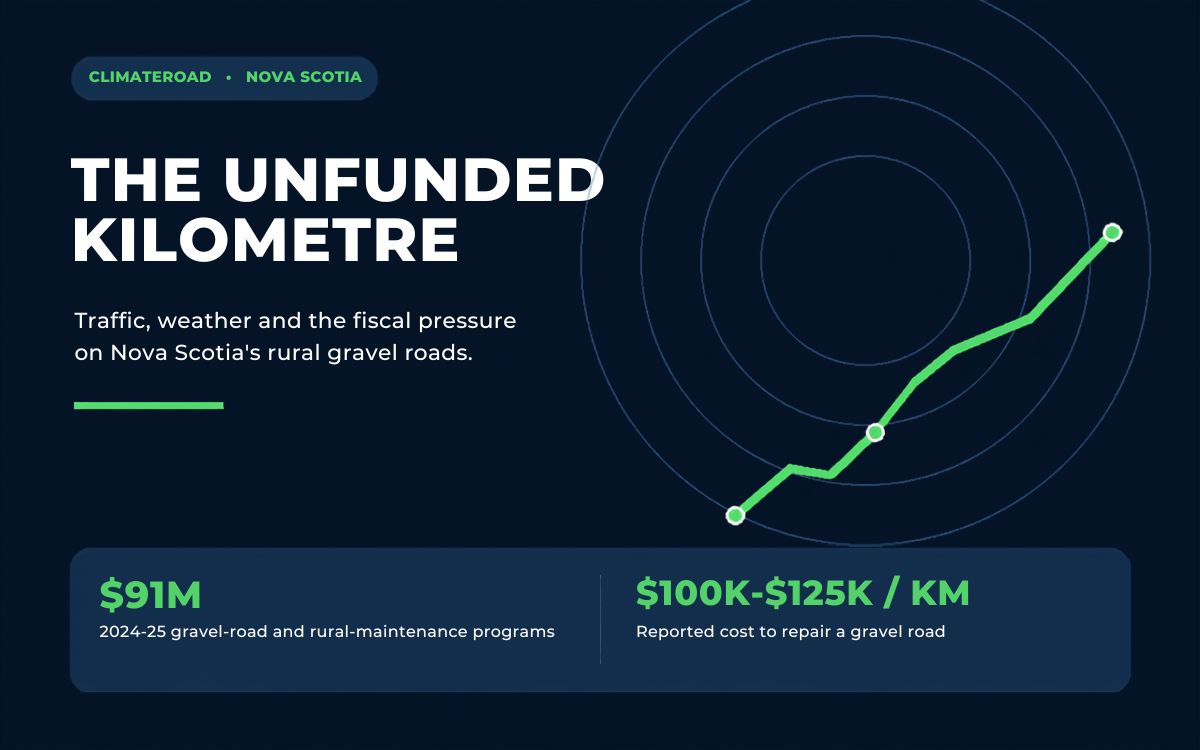
The province created its dedicated Gravel Road Capital Program in 2017 with an annual allocation of $10 million. By 2021 the program had increased to $40 million. For 2024-25 the province allocated $55 million for gravel roads and another $36 million to the Rural Impact Mitigation program for rural road maintenance and repair.
Together those two programs represented $91 million in planned provincial commitment. The increase demonstrates that Nova Scotia is responding seriously. It also reveals the scale and persistence of the underlying problem.
Provincial gravel-road and rural-maintenance program allocations. Figures are program totals rather than spending on every kilometre.
When annual spending approaches the cost of renewal
A provincial estimate published in 2021 placed the cost of repairing a gravel road at approximately $100,000 to $125,000 per kilometre with a service life of up to 15 years after proper repair.
For context, spreading the 2024-25 Gravel Road Capital allocation across the 8,400-kilometre network produces an analytical average of about $6,550 per kilometre. Annualizing the reported repair benchmark over 15 years produces approximately $6,700 to $8,300 per kilometre per year.
The figures are not directly interchangeable. Provincial allocations are not distributed evenly and roads have different conditions, traffic profiles and intervention needs. The comparison is still instructive: planned capital spending has reached the same broad order of magnitude as continuously renewing the network over its reported service horizon.
That is not evidence of overspending. It is evidence that the existing network requires substantial and recurring investment simply to preserve its current function.
The physics beneath the budget line
Traffic counts alone do not explain road wear. Axle weight matters because structural damage rises much faster than the load placed on the road.
The fourth-power relationship used in pavement analysis illustrates the sensitivity. Under that relationship, a 25 percent increase in axle load can produce approximately 2.44 times the relative structural effect. A 50 percent increase can produce more than five times the effect.
The relationship was developed for flexible pavements and should not be treated as a precise predictor for Nova Scotia's gravel roads. Its value here is explanatory. It shows why a modest increase in axle weight can matter far more than a similar increase in vehicle count and why heavy commercial traffic deserves specific attention in road planning.
Illustrative sensitivity under the standard fourth-power relationship. Not a Nova Scotia gravel-road performance forecast.
Weather amplifies the structural pressure
Water changes how a road carries load. When a gravel road becomes saturated, its bearing capacity can fall and the same vehicle can cause more deformation, rutting and aggregate loss than it would under dry conditions.
Nova Scotia's changing climate adds to this exposure. More intense precipitation can overwhelm drainage, erode shoulders, wash out culverts and turn gradual deterioration into an emergency reconstruction requirement. Freeze-thaw variability can add another cycle of weakening and repair.
Traffic and weather therefore cannot be planned for as separate risks. Heavy vehicles place stress on the road structure. Water reduces the structure's ability to withstand it. When they occur together the effect can compound.
Weather does not simply create another maintenance task. It can accelerate the same deterioration process the maintenance program is already working to contain.
The cost is larger than the road budget
A rural gravel road is not only a transportation asset. It may be a forestry route, an agricultural connection, a quarry corridor, an emergency-access route and the only dependable link for a community.
When that road deteriorates, the cost appears in several places: additional grading and aggregate, vehicle damage, interrupted deliveries, seasonal weight restrictions, emergency work and reduced reliability for the businesses and residents that depend on it.
This makes road criticality different from traffic volume. A lower-volume road can still be economically or socially essential when there is no practical alternative. The consequence of failure must be considered alongside the number of vehicles using the route.
A funding question and an engineering question
The public record raises a legitimate question about who should absorb the additional road burden created by strategic commercial activity. Residential property taxes alone may not be the fairest or most durable way to fund damage associated with forestry, quarry, agricultural or other heavy-haul traffic.
A stronger funding architecture may combine local contributions with provincial programs, federal infrastructure funding and appropriate participation from the economic activity generating the incremental load.
But changing who pays does not change the deterioration itself. More equitable funding can distribute the cost more fairly. It does not reduce the rate at which water, loading and material loss consume the road asset.
That leads to a second question: where repeated maintenance is signalling a structural performance problem, can the road be designed or treated differently so that it requires less intervention over its lifecycle?
What the evidence supports
Nova Scotia's public record supports several careful conclusions:
Rural gravel roads represent a significant portion of the provincial network.
Dedicated provincial investment has risen substantially since 2017.
Axle loading, moisture and drainage are important structural variables.
Extreme precipitation can convert gradual deterioration into sudden capital loss.
The value of a road depends on the communities and economic activities it connects, not traffic count alone.
The record does not establish a precise percentage by which climate change has increased gravel-road costs. Nor does it prove that a particular treatment will perform under Nova Scotia conditions. Those conclusions require local baseline data, controlled comparisons and performance monitoring.
That distinction matters. Strong infrastructure decisions are built by separating what the evidence already shows from what still needs to be demonstrated.
Five questions decision-makers are asking
Why are Nova Scotia’s rural gravel roads under increasing pressure?
A large gravel network is carrying changing traffic and commercial loads while water, extreme precipitation and freeze-thaw variability affect structural performance. Rising program allocations indicate that the resulting maintenance and renewal burden is persistent.
Why does axle weight matter more than vehicle count alone?
Road damage does not rise in a simple one-to-one relationship with axle load. Heavier axles can create disproportionately greater structural effects which is why traffic analysis should distinguish heavy-vehicle volume and axle profile from total vehicle counts.
Does the $91 million allocation mean every road receives the same investment?
No. The figure combines two province-wide programs and is not distributed evenly across the network. It provides context for the overall scale of commitment rather than a literal cost per kilometre.
Why is drainage central to gravel-road resilience?
Water infiltration and poor drainage can reduce bearing capacity, accelerate aggregate loss and increase the damage caused by traffic. Surface maintenance without attention to water movement may address the symptom without resolving the underlying failure mechanism.
What evidence is needed before changing the intervention?
Decision-makers need site condition, soil, drainage, traffic, axle loading, maintenance history and lifecycle-cost information. Any new approach should be evaluated against an appropriate conventional comparison under local conditions.
The cost of the unfunded kilometre
An unfunded kilometre is not simply a road without an adequate maintenance allocation. It is a kilometre whose economic and community importance, structural exposure and true lifecycle cost are not visible in the decision used to fund it.
Nova Scotia has already built an unusually transparent record of the problem. Its budgets, programs and engineering requirements show a province continually adapting to a rural road network under sustained pressure.
The next step is to use that evidence to distinguish the roads that need routine maintenance from those where recurring maintenance is evidence of a deeper structural problem.
If the deterioration curve itself can be changed, the conversation moves beyond who should pay for repeated repair to how much repair can be avoided in the first place.
LOOK BEYOND THE MAINTENANCE LINE
Explore how Climateroad can help identify where recurring maintenance is signalling a structural resilience problem and what evidence is needed before a different intervention is considered.
DISCUSS A PRIORITY CORRIDOR
Sources
Government of Nova Scotia - Budget 2024-25 Highlights: https://www.novascotia.ca/sites/default/files/documents/7-805/highlights-budget-2024-2025-en.pdf
Government of Nova Scotia - Government Invests in Road and Rink Improvements, September 27, 2021: https://news.novascotia.ca/en/2021/09/27/government-invests-road-and-rink-improvements
Government of Nova Scotia - Nova Scotia Road Network, Open Data Portal: https://data.novascotia.ca/Roads-Driving-and-Transport/Nova-Scotia-Road-Network-NSRN-/484g-adjn
Government of Nova Scotia - Nova Scotia's Changing Climate: https://climatechange.novascotia.ca/changing-climate
Government of Nova Scotia - 2025 Climate Change Risk Assessment: https://climatechange.novascotia.ca/sites/default/files/uploads/climate-change-risk-assessment-2025.pdf
Federal Highway Administration - Comprehensive Truck Size and Weight Study: https://www.fhwa.dot.gov/reports/tswstudy/TSWwp3.pdf
Federal Highway Administration - Long-Term Pavement Performance Pavement Loading User Guide: https://www.fhwa.dot.gov/publications/research/infrastructure/pavements/ltpp/13089/index.cfm
World Bank - Why Road Maintenance Is Important and How to Get It Done: https://documents.worldbank.org/en/publication/documents-reports/documentdetail/211191468323695241
