
Rural Road Resilience Demonstration for Nova Scotia
Beyond Maintenance
Building the evidence for more resilient rural roads in Nova Scotia
Nova Scotia has already demonstrated its commitment to rural roads. Dedicated gravel-road and rural-maintenance programs have grown substantially while drainage work, grading, aggregate replacement and reconstruction continue across the province.
The question is not whether maintenance remains necessary. It does. The question is whether recurring work at the same locations is sometimes evidence that the road structure, drainage or material behaviour no longer matches the conditions acting on the asset.
Where that is happening, more maintenance may restore service without changing the deterioration curve. A different response begins by diagnosing why the road is failing then testing whether an engineered intervention can reduce how often the failure returns.
The economic proposition is straightforward: if a road can make greater use of suitable material already in place and maintain its performance longer between interventions, the road authority may spend less on imported aggregate, grading, emergency repairs and reconstruction. The purpose of a Nova Scotia demonstration is to determine whether that proposition holds under local conditions and by how much.
Maintenance can reveal a structural problem
Grading, gravel replacement, dust control, ditching and culvert work are essential parts of operating a rural road network. They become less efficient when the same segment repeatedly develops rutting, potholes, aggregate loss, saturation or washout damage.
Those patterns are not merely maintenance costs. They are performance information. They can indicate that water is entering or remaining in the road structure, that the available material lacks sufficient bearing capacity for the traffic using it or that drainage and surface geometry are no longer working as a complete system.
The distinction matters because the intervention point changes. A surface symptom may require immediate repair. A recurring failure mechanism requires investigation below the surface.
Diagnose the road before selecting the treatment
Climateroad’s role is to diagnose the road first and select the intervention second. That means understanding the asset in the context of its actual location, traffic and purpose rather than applying a uniform treatment across an entire network.
A defensible diagnosis considers several forms of evidence together:
Road condition, geometry and existing material depth
Soil and aggregate properties including bearing capacity and moisture susceptibility
Drainage condition, culvert capacity, outlets and erosion pathways
Traffic volume, heavy-vehicle percentage and axle-loading profile
Maintenance frequency, aggregate replacement and emergency work history
Freeze-thaw, precipitation and site-specific climate exposure
Community, emergency-access and economic consequences of disruption
The result is not simply a condition score. It is a view of the failure mechanism, the consequence of allowing it to continue and the evidence an alternative intervention would need to produce.
Water and loading must be addressed as one system
For many gravel roads, water is the variable that determines how damaging traffic becomes. Saturated material can lose structural capacity which allows the same heavy vehicle to produce more deformation, rutting and aggregate displacement than it would under drier conditions.
This is why structural stabilization cannot be treated as a substitute for drainage engineering. Reducing uncontrolled infiltration into the road layer is valuable only when surface water also has somewhere to go.
A complete response may include stabilization together with an appropriate crown and crossfall, functioning ditches, adequate culvert capacity, reliable outlets and erosion protection. The road layer and the drainage system have to perform together.
The objective is not to make drainage less important. It is to give drainage engineering a more resilient road structure to protect.
Where enabling technologies may fit
Climateroad works with Polyroads as an enabling technology platform. Depending on the diagnosed failure mechanism, the platform provides options for structural stabilization, surface protection, dust and erosion control or cementitious treatment.
For a moisture-sensitive road with insufficient load-bearing capacity, SoilTech Mk III may be considered as part of the engineered response. For another road, drainage rehabilitation or a different treatment may be the more appropriate first intervention.
This is an important positioning distinction. A municipality does not have a polymer problem. It has a road-performance problem. The technology should be selected because it fits the engineering diagnosis, not because it is available.
Illustrative decision logic. The appropriate intervention depends on site-specific geotechnical and drainage assessment.
International experience is a starting point, not a Nova Scotia claim
Polyroads has reported international use under heavy-haul, high-rainfall and water-constrained conditions. Those cases help establish that the underlying technologies have been used against substantial loading and moisture challenges elsewhere.
They do not prove how a treated road will perform through Nova Scotia’s particular combination of saturation, freezing, thawing and refreezing. Nor do they establish the maintenance savings or lifecycle cost that a municipality or province should place into a Canadian business case.
That evidence gap is not a reason to make a stronger marketing claim. It is the reason to design a controlled local demonstration.
A Nova Scotia rural road resilience demonstration
The proposed next step is not a province-wide procurement decision. It is a controlled demonstration designed to determine whether an engineered road system can improve structural performance and reduce maintenance demand under Nova Scotia conditions.
The demonstration should begin with one or more representative road environments selected jointly with the participating road authority. Candidate segments should have a clearly documented problem, sufficient operational importance and a practical matched comparison.
Control sections make the evidence usable
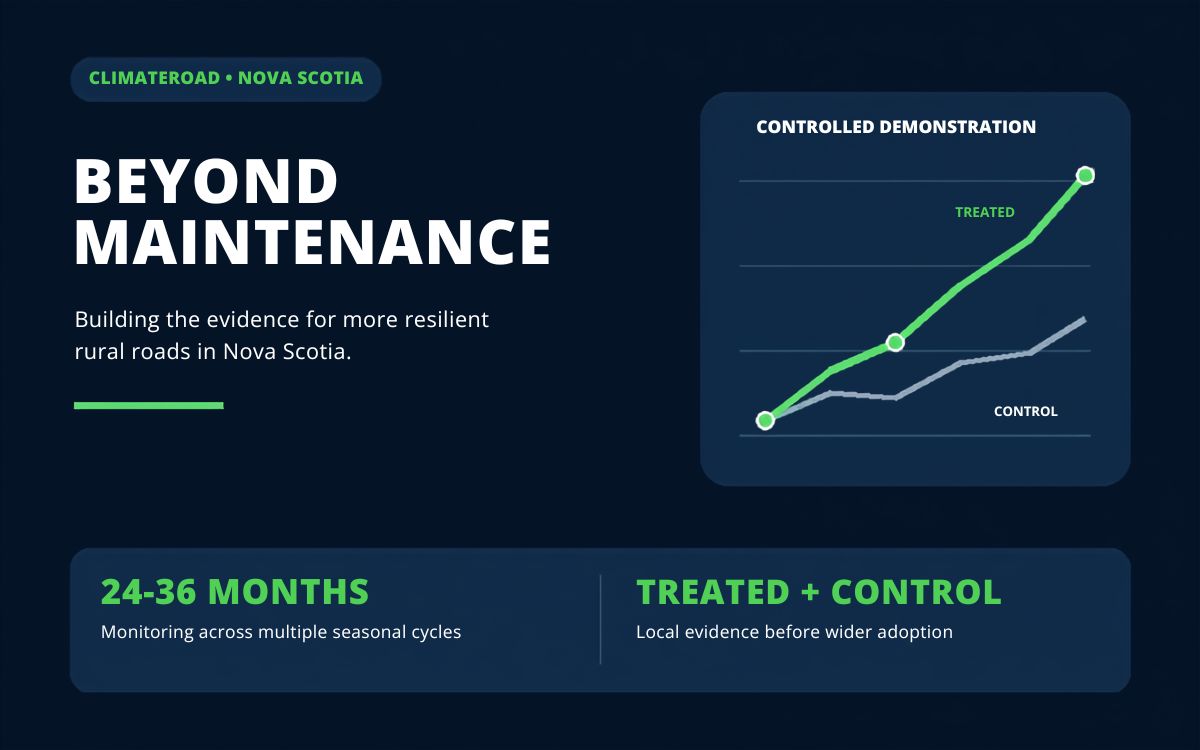
A treated road that appears to perform well does not by itself establish why. Traffic, weather, grading decisions and drainage work can all affect the result. A matched control section provides the comparison needed to distinguish treatment performance from normal variation.
The treated and conventional sections should be as similar as practical in soil, drainage, geometry, traffic and climate exposure. Both should be measured using the same methods and schedule.
Monitoring should ideally continue for 24 to 36 months so the comparison spans more than one winter and spring. A single mild season would not test the freeze-thaw and moisture conditions that matter most to Nova Scotia.
Measure what the road authority can use
The demonstration should produce engineering evidence and operating evidence. Laboratory improvements are relevant but the procurement question is ultimately whether the road requires fewer resources to deliver the same or better service.
The most useful outcome is not a statement that the treated road looks better. It is a quantified comparison showing how structural performance changed, how many maintenance interventions were avoided and what that difference means over the expected service life of the asset.
Five questions decision-makers are asking
Is Climateroad proposing that maintenance can be eliminated?
No. Every road requires inspection, drainage work and maintenance. The objective is to determine whether a more resilient road structure can reduce the frequency, severity and cost of recurring interventions.
Is Polyroads the Climateroad solution?
Polyroads is an enabling technology platform. Climateroad’s role is to diagnose the road, integrate the appropriate engineering response, oversee the evidence framework and determine whether a Polyroads treatment fits the failure mechanism.
Why not rely on the international case studies?
International experience supports further investigation but does not establish performance under Nova Scotia soils, moisture conditions and freeze-thaw cycles. Local validation is required before wider claims or adoption.
Why does the demonstration need a control section?
A control establishes what would have happened under conventional maintenance during the same traffic and weather conditions. Without it, the source of any observed improvement is difficult to defend.
What decision should the demonstration support?
It should determine whether the intervention delivers sufficient engineering performance and lifecycle value to justify broader application on roads with comparable conditions.
From a product trial to a public-infrastructure decision
A credible demonstration is not a showcase kilometre. It is a decision instrument. It begins with a documented problem, compares a treated section with a conventional one and produces evidence that engineers, finance teams and procurement authorities can examine together.
That is how Climateroad proposes to move beyond maintenance: not by asking Nova Scotia to accept an imported performance claim but by helping the province and its municipalities build the evidence needed to make their own decision.
The opportunity is to select a priority corridor where recurring maintenance is already signalling a deeper problem then determine whether a more resilient intervention can change the lifecycle outcome.
BUILD THE EVIDENCE BEFORE THE PROCUREMENT DECISION
Explore a controlled Nova Scotia rural road resilience demonstration built around local conditions, matched control sections and measurable lifecycle outcomes.
EXPLORE A RESILIENCE DEMONSTRATION
Sources
Government of Nova Scotia - Budget 2024-25 Highlights: https://www.novascotia.ca/sites/default/files/documents/7-805/highlights-budget-2024-2025-en.pdf
Government of Nova Scotia - Government Invests in Road and Rink Improvements, September 27, 2021: https://news.novascotia.ca/en/2021/09/27/government-invests-road-and-rink-improvements
Government of Nova Scotia - Nova Scotia Road Network, Open Data Portal: https://data.novascotia.ca/Roads-Driving-and-Transport/Nova-Scotia-Road-Network-NSRN-/484g-adjn
Government of Nova Scotia - Nova Scotia's Changing Climate: https://climatechange.novascotia.ca/changing-climate
Government of Nova Scotia - 2025 Climate Change Risk Assessment: https://climatechange.novascotia.ca/sites/default/files/uploads/climate-change-risk-assessment-2025.pdf
Federal Highway Administration - Long-Term Pavement Performance Pavement Loading User Guide: https://www.fhwa.dot.gov/publications/research/infrastructure/pavements/ltpp/13089/index.cfm
World Bank - Why Road Maintenance Is Important and How to Get It Done: https://documents.worldbank.org/en/publication/documents-reports/documentdetail/211191468323695241
Climateroad / Polyroads - supplied engineering and international case-study documentation: Reported partner information. International results are illustrative and are not presented as Nova Scotia-specific findings.
