
The Network Alberta Cannot Maintain the Same Way
Why rural road deterioration is outrunning fiscal capacity
Alberta's rural roads carry far more than local traffic. They connect farms to processors, resource sites to markets, workers to jobs, families to services and emergency responders to the communities that depend on them.
They are also maintained through a fiscal model that is increasingly out of step with the size, condition and economic role of the network.
The question is no longer whether Alberta needs to spend more on rural transportation infrastructure. It is whether additional funding, by itself, can keep pace with a network whose deterioration is already consuming more capacity than traditional maintenance budgets can replace.
A local network with provincial consequences
Members of the Rural Municipalities of Alberta manage approximately 130,000 kilometres of roads and about 8,000 bridges and culverts. RMA describes this as the largest road and bridge network managed by any stakeholder in the province.
That scale reflects Alberta's geography, but it also reflects the province's economy. Rural municipal roads support agriculture, forestry, energy, aggregate extraction, value-added processing and the movement of goods across long distances. Many exist because provincial and national economic activity requires dependable access far beyond Alberta's major highways.
The benefits travel widely. Much of the responsibility for maintaining the enabling infrastructure remains local.
This creates a difficult mismatch. A road may carry heavy commercial traffic that contributes to provincial growth, while the municipality responsible for maintaining it must rely on a comparatively narrow local revenue base. Where industrial assessment is unstable or infrastructure demands rise faster than municipal revenue, the pressure becomes even harder to absorb.
The annual cost of standing still
RMA's 2024 Road Asset Deficit Report estimated that Alberta's rural municipal road portfolio had an overall condition rating of 60.76 percent. The report placed the network's condition-adjusted value at $21.95 billion, compared with $33.94 billion at its target condition, producing an estimated road infrastructure deficit of $11.99 billion.
Its most striking figure is the annual holding cost.
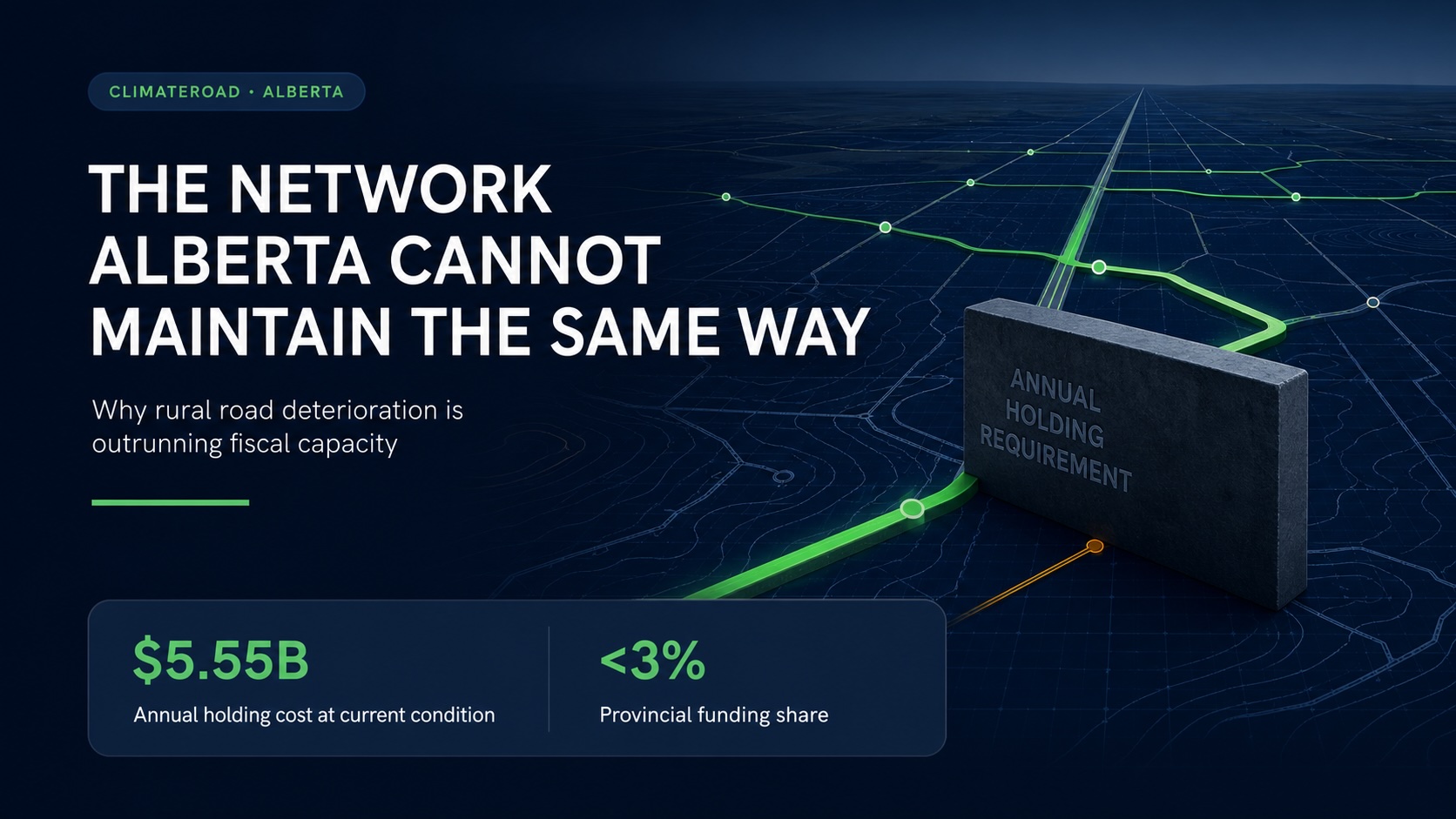
RMA estimated that maintaining the road portfolio at its current condition, without allowing it to deteriorate further, would require approximately $5.55 billion each year. That is not a reported annual municipal road expenditure. It is a modelled estimate of the investment needed to offset annual deterioration and return the portfolio to the same condition from one year to the next.
The distinction matters. The figure should not be read as a literal annual budget request. It does, however, show the scale of the underlying asset-management problem. When a network has already moved well down its deterioration curve, simply preventing further decline can become extraordinarily expensive.
RMA's current transportation position statement says provincial funding covers less than three percent of the estimated $5.55 billion annual requirement. The comparison is not a complete accounting of every municipal, provincial, federal or industry contribution. It is an indication that established funding channels operate at a very different scale from the modelled need.
Why more funding cannot be the only answer
Stable, predictable infrastructure funding is necessary. Rural municipalities cannot close a gap of this size through property taxation alone, especially where a small population is supporting infrastructure used by high-value economic activity.
Alberta already has programs that recognize this shared interest. The Strategic Transportation Infrastructure Program supports local roads, bridges, resource roads and other transportation priorities. Its goals include improving the movement of goods, supporting economic growth and extending infrastructure service life. The Resource Road Program also encourages municipal and private-sector cost sharing.
Those are important building blocks. Yet a larger funding envelope applied to the same recurring deterioration cycle may still leave road authorities spending more without changing how quickly the asset loses performance.
That cycle is familiar:
A road deteriorates under traffic, moisture and seasonal conditions.
Grading, gravel replacement, drainage work or emergency repairs restore service.
Available funding and staff capacity are consumed by the immediate need.
More durable renewal or redesign is postponed.
The road returns to the same failure pattern and the cycle begins again.
Maintenance will always be required. The concern is not maintenance itself. It is the point at which repeated maintenance becomes evidence that the road's design, material, drainage or structural capacity no longer matches the demands placed on it.
A kilometre is not important because it is busy
Traffic volume is an important planning measure, but it does not capture the full value of a rural road.
A lower-volume route may be the only practical connection to a farm cluster, an industrial site, a processing facility, emergency care or an entire community. A seasonal agricultural road may carry its most consequential traffic during a short harvest window. A resource route may support a level of economic activity far beyond the number of residents living beside it.
This is why road criticality must include consequence as well as use. Decision-makers need to know what the route enables, who depends on it, whether an alternative exists and what happens when access becomes restricted or unreliable.
The cost of failure does not remain within the road department. It appears in delayed deliveries, longer detours, equipment damage, seasonal restrictions, emergency response, reduced investment confidence and higher costs for the industries and communities using the route.
The maintenance budget is carrying a productivity problem
Alberta is often described as having a rural gravel-road problem. That description is too narrow.
The deeper issue is rural-road productivity: how many reliable, serviceable kilometres a municipality can maintain with the funding, equipment, staff and aggregate available to it.
If a road consumes repeated grading, gravel replacement and emergency work without delivering a longer service interval, the municipality is not only paying a maintenance cost. It is losing the opportunity to use those same resources elsewhere in the network.
This changes the strategic question. Rather than asking only how much additional money is required, road authorities can also ask where a different engineering or asset-management decision could reduce the rate at which the network consumes the budget.
From a funding list to an investment priority
No province or municipality can rebuild every rural road at once. The immediate challenge is prioritization.
A defensible process brings several forms of evidence together:
Current road condition and expected remaining service life
Traffic volume, truck percentage and axle-loading profile
Agricultural, industrial and community dependence on the route
Drainage, soil, aggregate and moisture conditions
Spring breakup, freeze-thaw and extreme-precipitation exposure
Maintenance frequency, gravel consumption and recurring emergency work
Detour availability and the consequences of disruption
Lifecycle cost and the expected value of alternative interventions
This evidence helps distinguish roads that need routine maintenance from roads where recurring intervention may be signalling a deeper structural mismatch.
It also supports better funding decisions. A project is easier to explain and defend when decision-makers can show not only that a road is in poor condition, but why its performance matters, which failure mechanism is driving cost and what an investment is expected to change.
Where Climateroad fits
Climateroad helps municipalities identify which roads are consuming disproportionate maintenance resources and where a different approach may be worth testing.
The process begins with the road system, not a predetermined treatment. Climateroad brings together road condition, traffic, climate, geotechnical and maintenance data to help answer three practical questions:
Which road segments are driving recurring costs?
What is causing the repeated deterioration?
Where could an engineered intervention be tested against conventional maintenance?
Is one road consuming more gravel, grading time or emergency attention than it should? Climateroad can help determine whether it presents a credible case for testing a different approach.
Five questions decision-makers are asking
What does the $5.55 billion figure represent?
It is RMA's modelled annual holding cost for keeping the rural municipal road portfolio at its reported current condition. It is not a reported annual municipal expenditure or a single-year funding request. It estimates the investment required to offset deterioration and prevent the portfolio's overall condition from declining further.
Why are Alberta's rural roads a provincial economic issue?
Rural municipal roads support agriculture, energy, forestry, aggregate, processing, and freight activities that contribute to the broader Alberta economy. When those routes deteriorate or become restricted, the effects can appear in supply chains, emergency access, business costs, and investment decisions well beyond the municipality that maintains the road.
Would more provincial funding solve the problem?
More stable and predictable funding is necessary, but funding alone may not alter the rate of deterioration. Where the same road repeatedly requires grading, gravel replacement or emergency work, decision-makers should also investigate drainage, materials, loading, subgrade and structural capacity.
How should Alberta decide which roads to address first?
Prioritization should combine condition, heavy-vehicle exposure, economic and community importance, climate and drainage risk, maintenance history, detour availability and lifecycle cost. Traffic volume alone does not reveal the consequences of a route failing.
How can Climateroad support the next step?
Climateroad can help organize road, traffic, climate, geotechnical and maintenance evidence into defensible priorities, then structure local treated-versus-control demonstrations where a different intervention appears justified. The aim is to produce Alberta-specific evidence on performance and lifecycle costs before wider adoption.
The road ahead
Alberta cannot maintain 130,000 kilometres of rural roads through a single treatment, a single funding program or a single definition of what makes a road important.
What it can do is make the network's economic role, deterioration pattern and true lifecycle burden more visible.
The costliest assumption is that the maintenance model that produced today's condition will somehow produce a different result tomorrow. The alternative is to use better evidence to decide where maintenance is sufficient, where the road system must be changed and where a controlled Alberta demonstration can establish what a more durable approach is worth.
The next article in this series will examine the forces underneath the budget line: heavy loading, moisture, spring breakup, freeze-thaw and the aggregate replacement cycle that keeps many rural roads under pressure.
Sources
2. Rural Municipalities of Alberta, Asset Deficit Summary Report: Roads, 2024
3. Rural Municipalities of Alberta, Rural Industry and Economic Development Position Statement, 2026
4. Government of Alberta, Strategic Transportation Infrastructure Program
5. Government of Alberta, Local Government Fiscal Framework capital funding
Editorial note: The $5.55 billion annual holding cost and related portfolio values are modelled estimates published by RMA. They are presented as indicators of asset-management scale, not as audited annual municipal expenditures or demonstrated Climateroad savings.
