
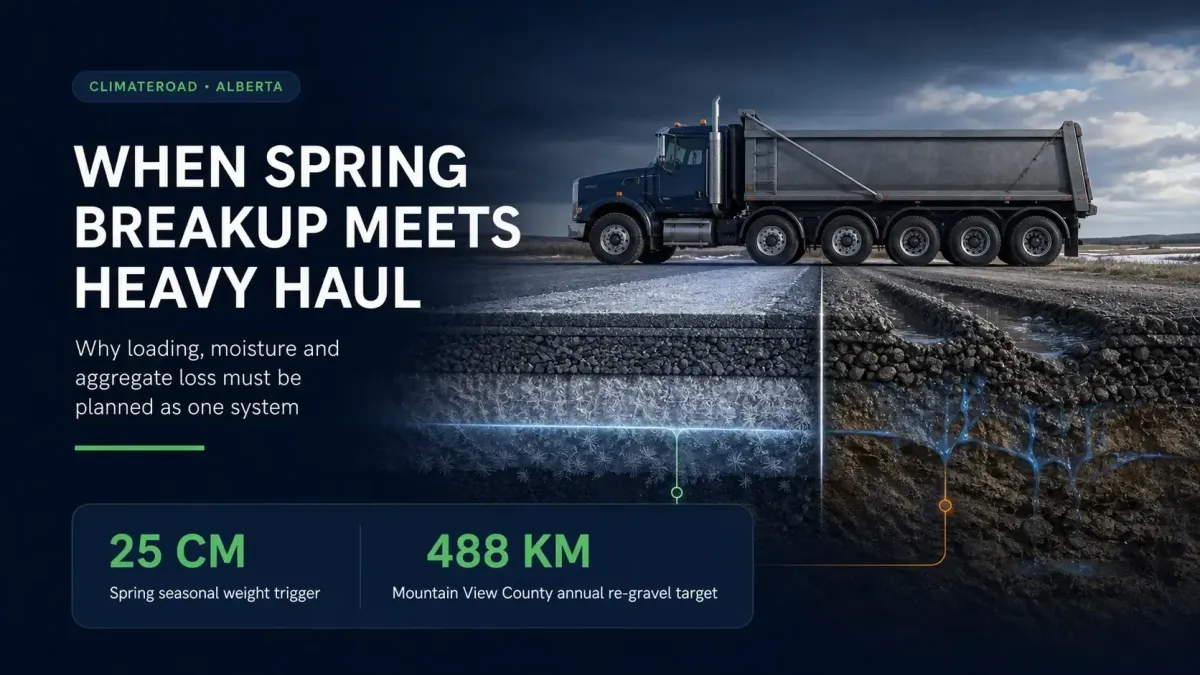
When Spring Breakup Meets Heavy Haul
Why loading, moisture and aggregate loss must be planned as one system
A rural road does not experience traffic in the abstract. It experiences each axle through the condition of the road at that moment.
The same truck can have a very different effect on a dry, well-drained road than it does on a saturated road during spring breakup. Load matters. So do moisture, temperature, drainage, aggregate depth and the strength of the soil beneath the road.
For Alberta municipalities, these factors converge in the maintenance budget. When they are planned separately, the result can be a cycle of grading, regravelling and temporary restrictions that restores service without reducing the road's underlying rate of loss.
The equation underneath the maintenance budget
Road deterioration is often discussed as if one variable is responsible. Heavy trucks are blamed. Weather is blamed. Drainage is blamed. In practice, damage emerges from the interaction among them.
A useful planning model begins with five connected factors:
Traffic volume and the proportion of heavy vehicles
Axle configuration and loading
Moisture entering, crossing or remaining in the road structure
Freeze-thaw timing and the duration of weak conditions
Aggregate quality, layer thickness and subgrade strength
None of these measures is sufficient by itself. A high truck count may be manageable on a road with adequate structure and drainage. A lower-volume road may deteriorate rapidly when heavy loads arrive during a short period of saturation or thaw. The maintenance history makes sense only when the variables are read together.
Why does axle weight change the calculation
Alberta's pavement design guidance uses equivalent single-axle loads (ESALs) to translate mixed traffic into a common measure of structural loading. The underlying pavement relationship is commonly described as a fourth-power effect: a comparatively small increase in axle load can produce a much larger increase in pavement damage.
The Alberta Pavement Design Manual illustrates the effect this way. One application of a 100-kilonewton single axle is treated as approximately 2.5 applications of an 80-kilonewton axle. About 62 applications of a 50-kilonewton axle are required to equal one application of the 80-kilonewton reference axle.
This is a paved-road design relationship, not a ready-made prediction for gravel-road deterioration. Gravel roads respond differently, and local soils, moisture and maintenance practices can dominate the outcome. The principle remains useful: vehicle count alone can conceal the structural significance of axle loading.
That is why Alberta's ESAL guidance calls for engineering judgment. It notes that short traffic counts can distort annual loading estimates on resource roads when most truck activity occurs during a particular season. A credible baseline must capture when heavy traffic occurs, not simply how many vehicles pass during an average day.
Spring breakup is a loss of structural reserve
Frozen ground can temporarily support loads that the same road cannot carry during thaw. Alberta's seasonal weight programs reflect this physical reality. Winter weights begin when frost depth reaches at least 75 centimetres. Spring weights are triggered when thaw depth reaches at least 25 centimetres. Road bans may then reduce the maximum permitted weight to protect infrastructure during weaker conditions.
As thaw progresses from the surface downward, water can be trapped above soil that remains frozen. The aggregate and subgrade lose stiffness while heavy loads continue to apply stress. Rutting, pumping, soft spots and surface deformation may appear quickly because the road has lost part of its structural reserve.
A restriction is therefore not proof that a road has failed. It is a risk-management tool. It also tells planners something important: timing is part of the loading problem. The same annual tonnage may create different maintenance consequences depending on how much of it moves during the weakest weeks of the year.
Water turns load into damage
Moisture is the multiplier that can turn routine traffic into rapid deterioration. It may enter through precipitation, snowmelt, ditches, shoulders, culverts, groundwater or a surface that no longer sheds water effectively.
Once water remains in the road structure, the aggregate can lose interlock and the subgrade can lose bearing strength. Wheel loads then displace material rather than being distributed through a stable layer. Grading can reshape the surface, but it cannot by itself restore a weak subgrade, correct poor drainage or replace aggregate that has migrated out of the running surface.
This is why a maintenance response must begin with diagnosis. Repeated rutting in a wet location may call for drainage or structural work. Loose surface material may indicate aggregate quality or gradation issues. Washboarding may be influenced by speed, traffic, moisture and surface composition. Similar-looking symptoms do not necessarily have the same cause.
The aggregate cycle
Grading is highly visible, but aggregate replacement can be the larger economic lever. Every tonne of gravel that leaves the useful road profile must eventually be sourced, hauled, placed and shaped again. The cost is not only the material. It includes truck time, fuel, equipment, staff, traffic disruption and the distance between the pit and the road.
Local programs show the scale of this recurring work. Mountain View County says its annual re-gravel program targets approximately 488 kilometres of road. Lacombe County reports that gravel roads are graded, on average, every 2.5 weeks when weather permits. These figures describe different activities in different municipalities. They are not a province-wide average, but together they show how much operating capacity can be tied to recurring surface maintenance.
The most useful question is not whether grading or gravel is necessary. Both will remain part of rural road management. The question is where repeated intervention signals a preventable loss mechanism and where a different treatment could extend the interval before the next pass, load or emergency repair.
Traffic and weather cannot be planned separately
Alberta's heaviest rural road demands are often seasonal. Agricultural movements, resource hauling, construction and aggregate transport may concentrate traffic into short operating windows. Spring thaw and extreme precipitation are also time-dependent. When those windows overlap, annual averages hide the period that actually drives damage.
Planning should therefore connect road condition data with traffic timing, axle profiles and weather or moisture observations. This helps distinguish a route with consistently high demand from one whose risk is concentrated in several critical weeks. It also supports more precise choices, such as targeted drainage work, seasonal routing, load coordination, spot strengthening or a pilot treatment on a repeatedly failing segment.
What a useful baseline must measure
Before selecting an intervention, a municipality needs enough evidence to describe the current road and the cost of keeping it serviceable. At a minimum, a project baseline should include:
Heavy-vehicle percentage, axle configuration and the seasonal timing of loads
Surface condition, rutting, crossfall and locations of recurring soft spots
Drainage condition, moisture exposure, subgrade and aggregate characteristics
Grading events, equipment hours and emergency callouts by road segment
Tonnes of aggregate placed per kilometre and the full delivered cost
Road-ban history, service restrictions and weather-related closures
Detour length, economic dependence and the consequence of losing access
Comparable untreated segments or another credible control for evaluation
This information turns a maintenance anecdote into an investment case. It establishes what the road currently consumes and creates a basis for testing whether a different approach changes that consumption.
Where Climateroad fits
Climateroad's role is not to claim that one treatment solves every Alberta road problem. It is to help road authorities identify the loss mechanism, choose a fit-for-purpose intervention and measure whether the result improves service life or reduces recurring maintenance demand.
On one road, drainage may be the priority. On the other hand, aggregate retention, structural reinforcement or subgrade stabilization may matter more. The credible path is diagnosis first, treatment second and comparison over time.
A well-designed pilot should define success before work begins. Depending on the road, that may mean fewer grading passes, lower gravel consumption, reduced rut depth, fewer restrictions, better wet-weather access or a lower annual cost per serviceable kilometre. Claims should follow the measured result, not precede it.
Frequently asked questions
What is spring breakup?
Spring breakup is the period when frozen road materials and subgrade thaw and temporarily lose strength. Meltwater and incomplete drainage can leave the road especially vulnerable to heavy loading.
Why do heavier axles matter so much?
Road response is not proportional to vehicle count alone. Pavement design uses ESALs to reflect the much greater structural effect of heavier axle loads. Gravel-road performance requires local evidence, but axle profile and timing remain essential measures.
Do road bans mean the road has failed?
No. Road bans and seasonal weights are preventive tools used to reduce damage when road strength is temporarily lower. Their frequency and location can still help identify vulnerable segments.
Why focus on aggregate instead of grading alone?
Grading restores shape. Regravelling replaces material. Because aggregate must be sourced and hauled, persistent material loss can carry a substantial lifecycle cost that is not visible in grading frequency alone.
What evidence is needed before testing an intervention?
The strongest pilots record the road's existing condition, traffic and axle profile, moisture and drainage context, maintenance frequency, aggregate use and cost. They also use a comparable untreated segment or another defensible control.
The next question is proof
Alberta does not need another catalogue of road problems. It needs a practical way to show which interventions produce more reliable kilometres from the resources already being spent.
The final article in this series will set out an Alberta proof model: how to choose representative sites, establish matched baselines, measure maintenance avoided and decide whether a successful local result is ready to scale.
Sources
Government of Alberta, Road restrictions and bans
Government of Alberta, Equivalent Single Axle Loadings for pavement design
Alberta Transportation, Pavement Design Manual
Government of Alberta, Commercial vehicle oversize and overweight permits
Mountain View County, County roads and infrastructure
Lacombe County, Road maintenance
Government of Alberta, Strategic Transportation Infrastructure Program
Editorial note
The ESAL and fourth-power discussion in this article comes from paved-road design guidance and is used to explain why axle loading matters. It is not presented as a predictive formula for gravel-road deterioration. The Mountain View County and Lacombe County operating figures are local examples and should not be interpreted as Alberta-wide averages. Climateroad performance and savings claims should be based on measured, site-specific trials.
