
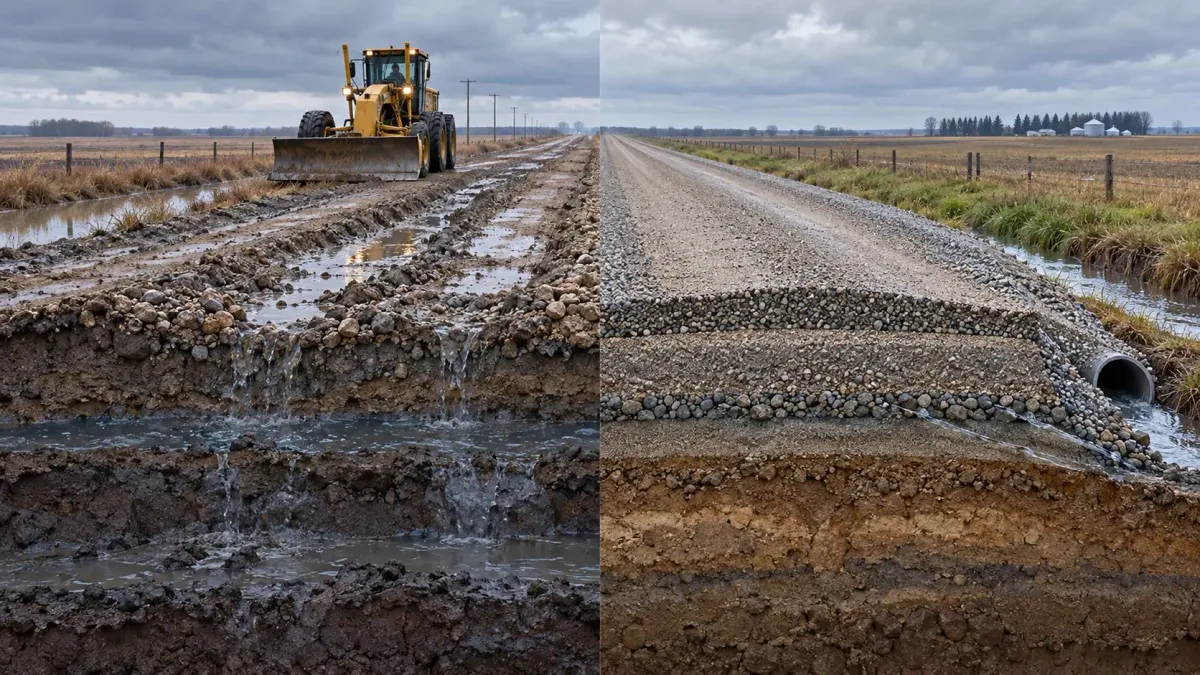
Why Manitoba's Rural Road Maintenance Model Is Reaching Its Limit
Grading can restore a road's shape. New aggregate can replace material lost to traffic, dust and erosion. Neither action necessarily changes the weakness that allowed the road to deteriorate in the first place.
When moisture, freeze-thaw cycling and heavy axle loads repeatedly act on a road with limited structural reserve, surface maintenance can become a recurring response to a deeper problem.
The road is repaired, exposed to the same conditions and repaired again. Over time maintenance becomes the operating model rather than a means of preserving a stable asset.
Two pressures reinforce one another
Manitoba's rural roads face an economic load and a climate load at the same time.
The economic cycle begins with more production and freight movement. Heavier and more frequent truck traffic increases road wear. Higher maintenance spending then leaves less fiscal capacity for capital renewal, sending a weaker road into the next traffic cycle.
The climate cycle begins with greater moisture exposure through spring flooding, rainfall and thaw. Saturated material loses bearing strength, which makes the road more sensitive to axle loading. Rutting and deformation allow more water to enter and the cycle accelerates.
These are not separate road problems. They interact at the point where tire load meets weakened material.
Water decides how much load the road can carry
Manitoba's spring road restrictions recognize a basic engineering fact: a road cannot safely carry its normal load when environmental conditions reduce its bearing capacity.
Water fills pore space and weakens the relationship between particles in the road material and subgrade. Repeated freezing and thawing can further disturb that structure. Under heavy loads the weakened road is more likely to rut, deform and lose surface material.
Drainage remains essential. Ditches, culverts, crowns and outlets must move water away from the road. The larger opportunity is to combine effective drainage with an engineered road structure that is less vulnerable when moisture reaches it.
Axle weight matters more than vehicle count alone
Two roads can record similar traffic volumes and experience very different deterioration. The weight and configuration of the vehicles, the timing of their movement and the road's moisture condition all influence the damage produced.
Manitoba's pavement guidance and seasonal restrictions treat loading as a structural variable for good reason. A road designed for an earlier freight pattern may have too little reserve for today's agricultural equipment or heavy commercial traffic, particularly during marginal spring conditions.
This is why a credible road assessment should record axle-loading profiles and heavy-vehicle seasonality rather than relying only on total traffic counts.
A partnership perspective for discussion
“The issue is not whether Manitoba knows how to maintain gravel roads. It is whether the current model can keep absorbing more traffic, more water and more freeze-thaw stress without changing the road underneath.”
The operating-expenditure trap
Every dollar spent restoring the same failure is a dollar unavailable for reducing the probability of the next one. That does not make maintenance wasteful. It means the system may be asking maintenance to perform a job it was not designed to do.
Where the failure is structural, the intervention must address structure. Where water is the dominant mechanism, drainage and moisture susceptibility must be addressed together. Where loading is the issue, the treatment must create enough capacity for the traffic the road is expected to carry.
The practical sequence is diagnosis first and treatment second. A single road may require different responses by segment because soils, drainage, geometry and loading are rarely uniform from one end to the other.
Changing the deterioration curve
Climateroad's proposition is to intervene before recurring deformation becomes the accepted cost of service. The road is assessed, segmented by failure mechanism and engineered using the combination of stabilization, drainage, surface protection or erosion control appropriate to the site.
For a structurally weak or moisture-sensitive section, SoilTech Mk III may form part of the engineered response by binding suitable in-situ material into a more cohesive load-bearing layer. Other Polyroads technologies may be considered where surface sealing, dust control or a cementitious treatment is appropriate.
The intervention is not a uniform product application and it does not replace local engineering judgment. It is a treatment hierarchy governed by the diagnosed road problem.
Manitoba must build its own evidence
International Polyroads projects demonstrate experience under heavy haul, high rainfall and other demanding conditions. They do not prove performance under Manitoba's prairie soils, flood-saturated subgrades or repeated deep freeze-thaw cycles.
That gap is not a reason to make a larger claim. It is the reason to conduct a controlled Manitoba demonstration.
The next article sets out how treated and conventional sections can be compared through the conditions that matter, with engineering and commercial thresholds agreed before construction begins.
Frequently asked questions
Why does grading not solve every road problem?
Grading restores surface shape but may not improve a weak or moisture-sensitive layer beneath the surface. If the failure mechanism remains, rutting and surface loss can return under the same traffic and weather conditions.
Why are spring road restrictions necessary?
Road strength can decline when thaw and moisture weaken the structure. Temporary loading restrictions help protect roads during this vulnerable period.
Is drainage enough to create a resilient road?
Drainage is fundamental but it may not correct inadequate material strength or load-bearing capacity. The road system must be assessed as a combination of drainage, materials, structure, geometry and traffic.
Does Climateroad apply one treatment to every road?
No. Climateroad's approach begins with diagnosis and selects the intervention by failure mechanism. Different segments may require different combinations of stabilization, drainage, sealing or surface treatment.
Has the approach been proven under Manitoba conditions?
Not yet. International experience supports further investigation but Manitoba-specific performance must be established through local testing, controlled comparison and monitoring across relevant seasonal conditions.
